BuildingFutures
Growing with values, learning with purpose.
One unbroken journey from a child's first English words at seven to confident, independent communication at thirteen.
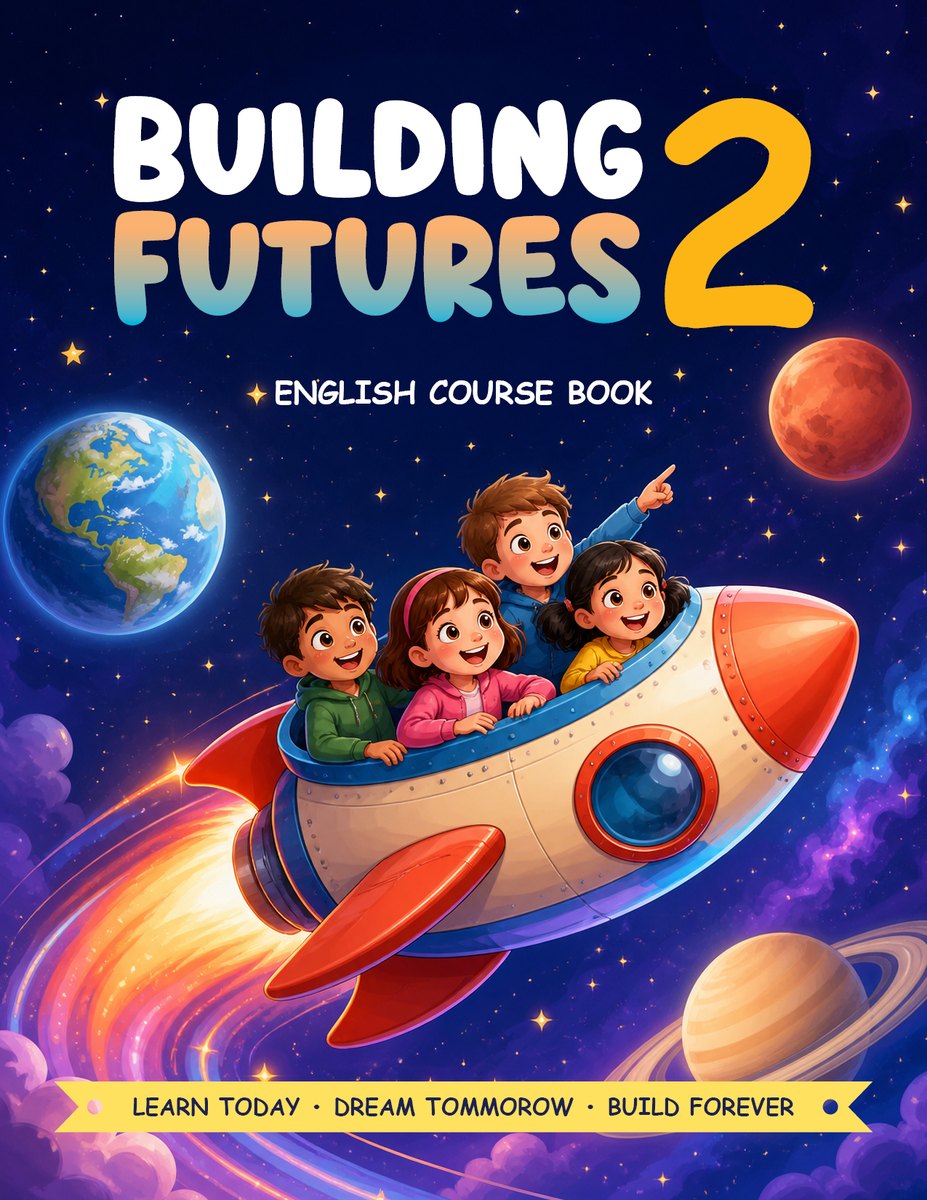
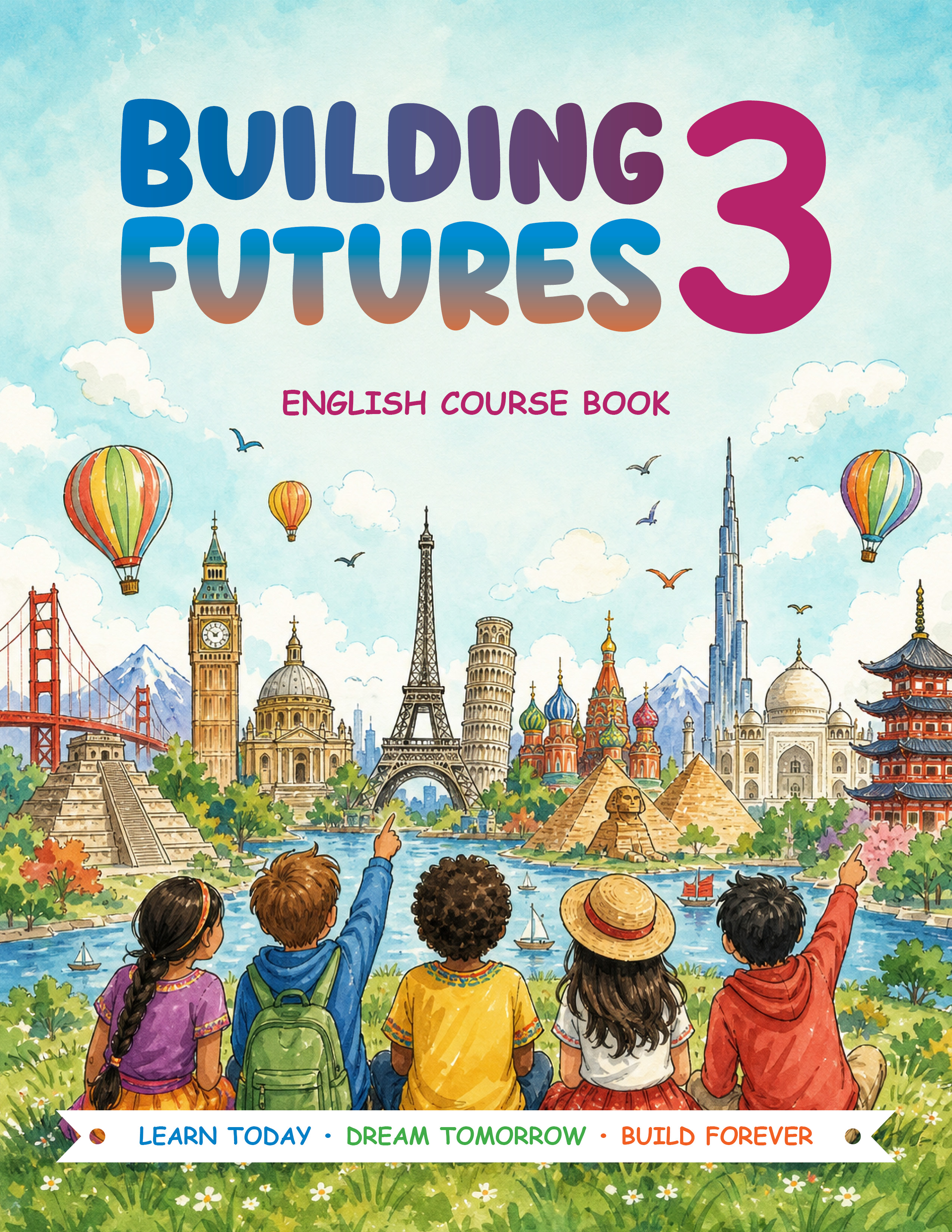
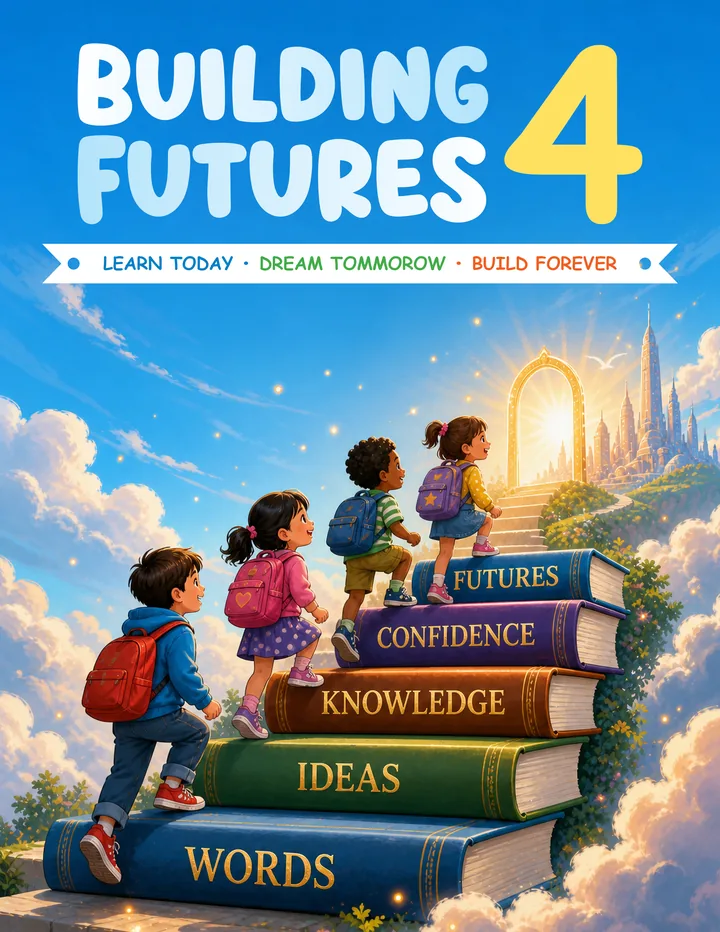
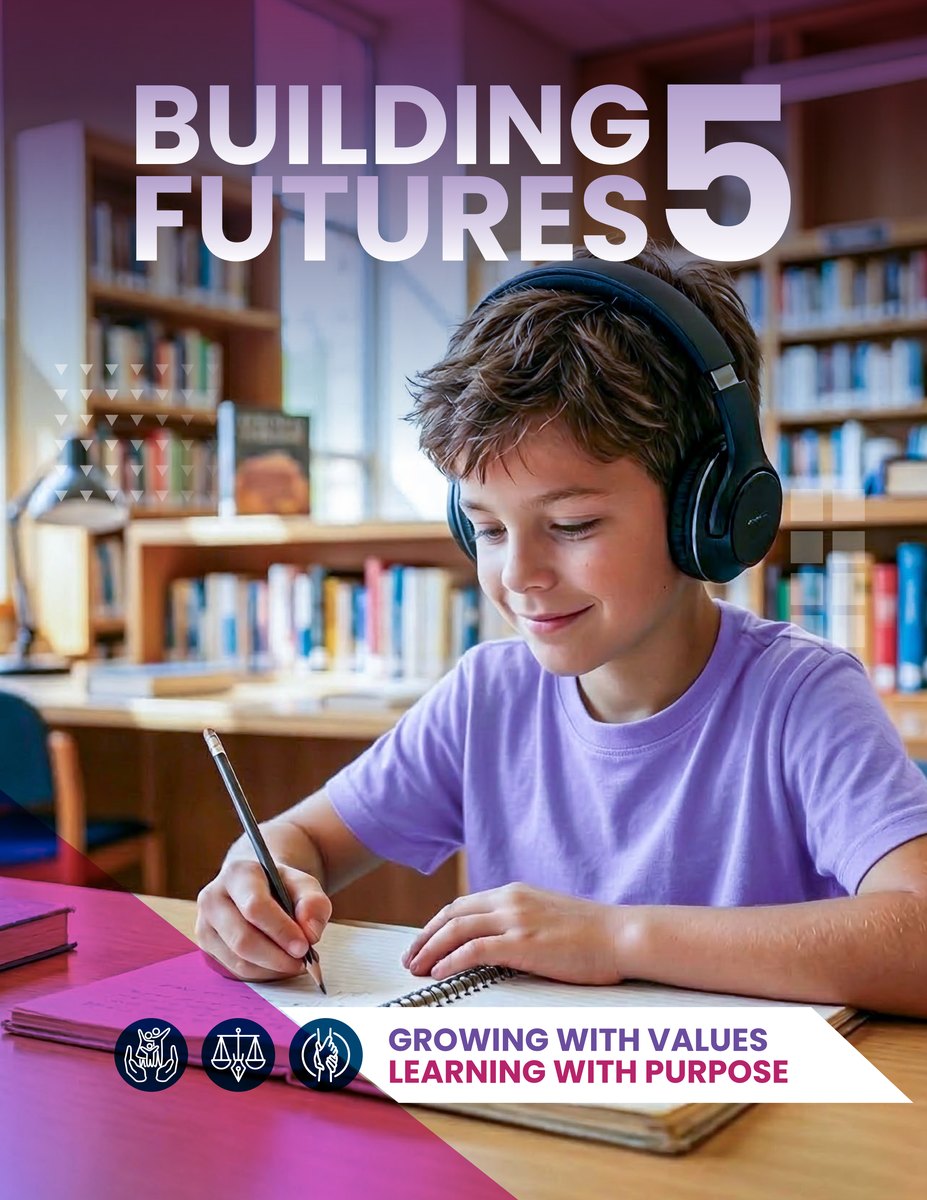
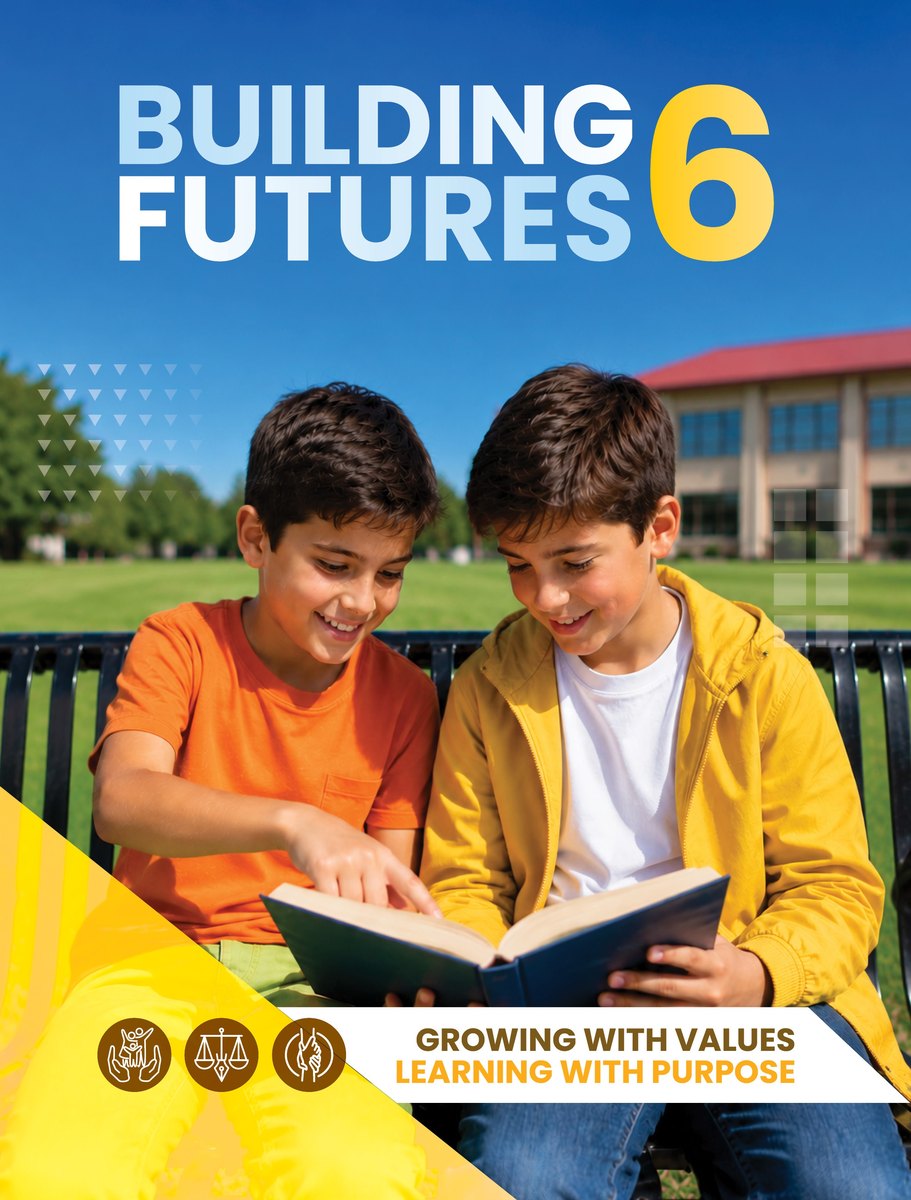
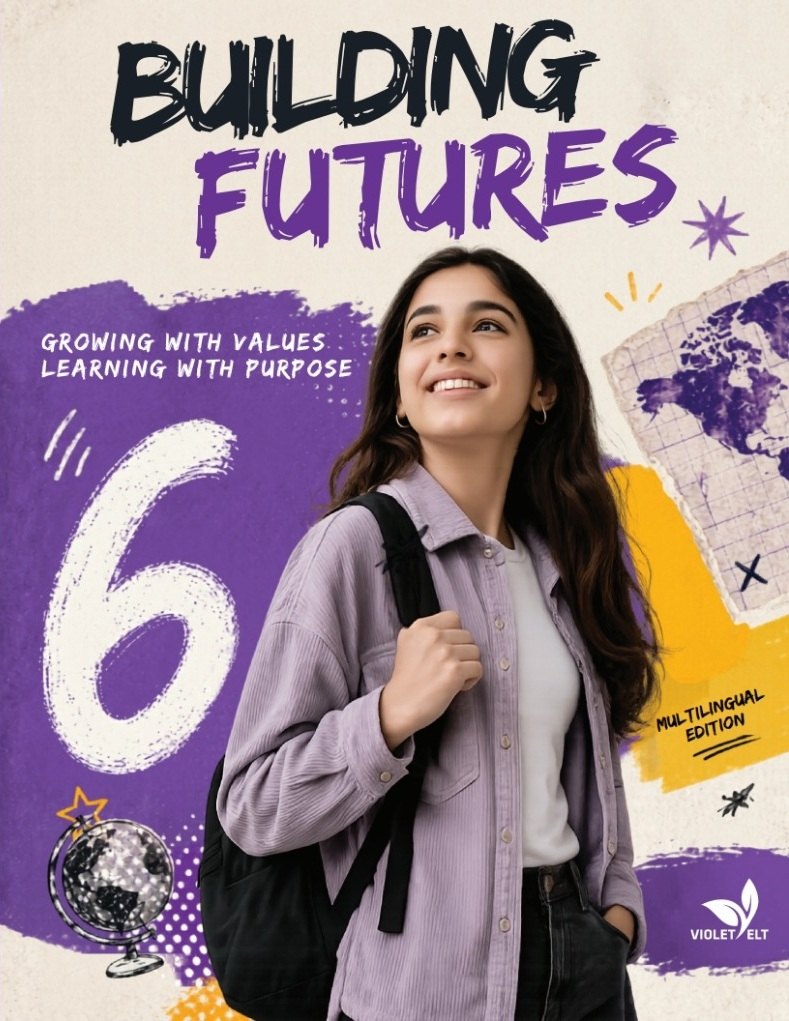
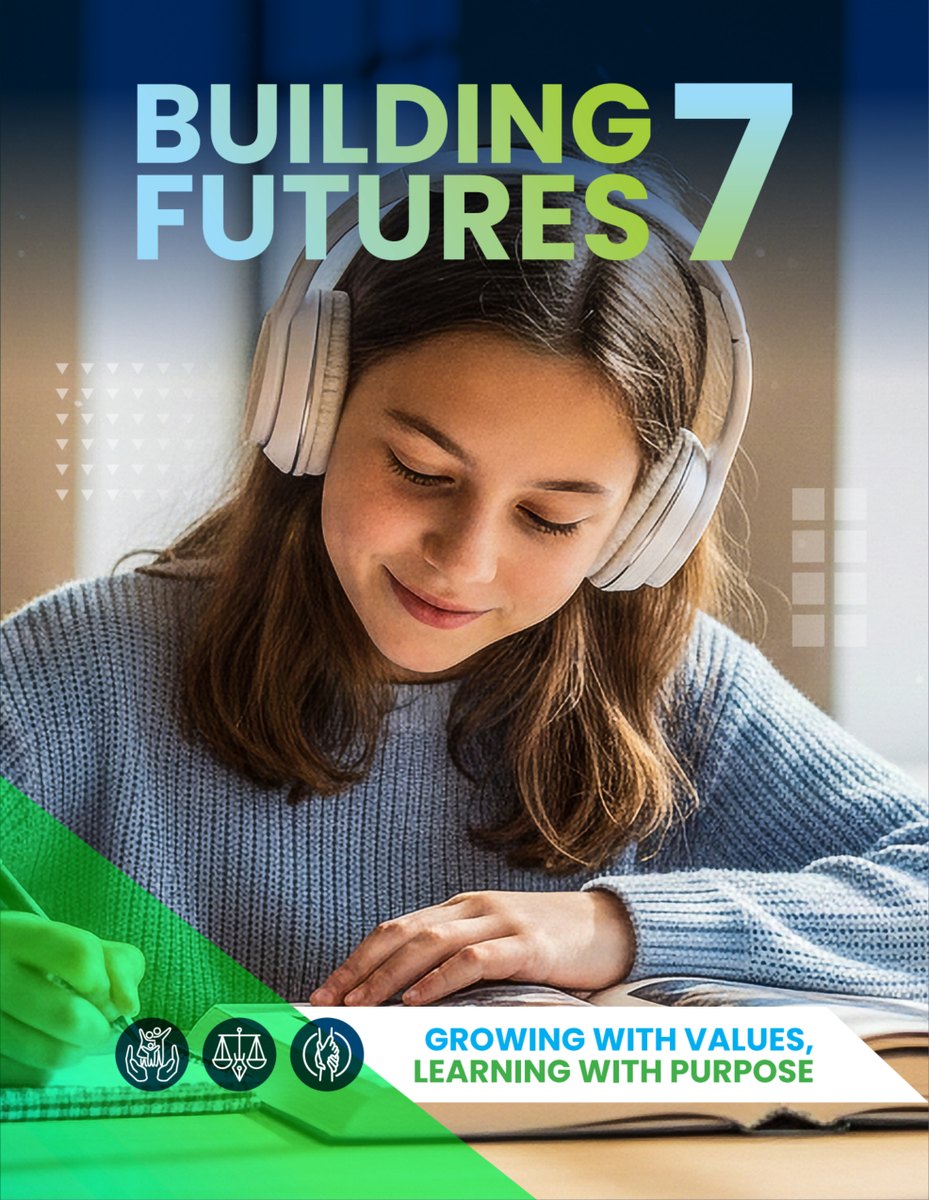
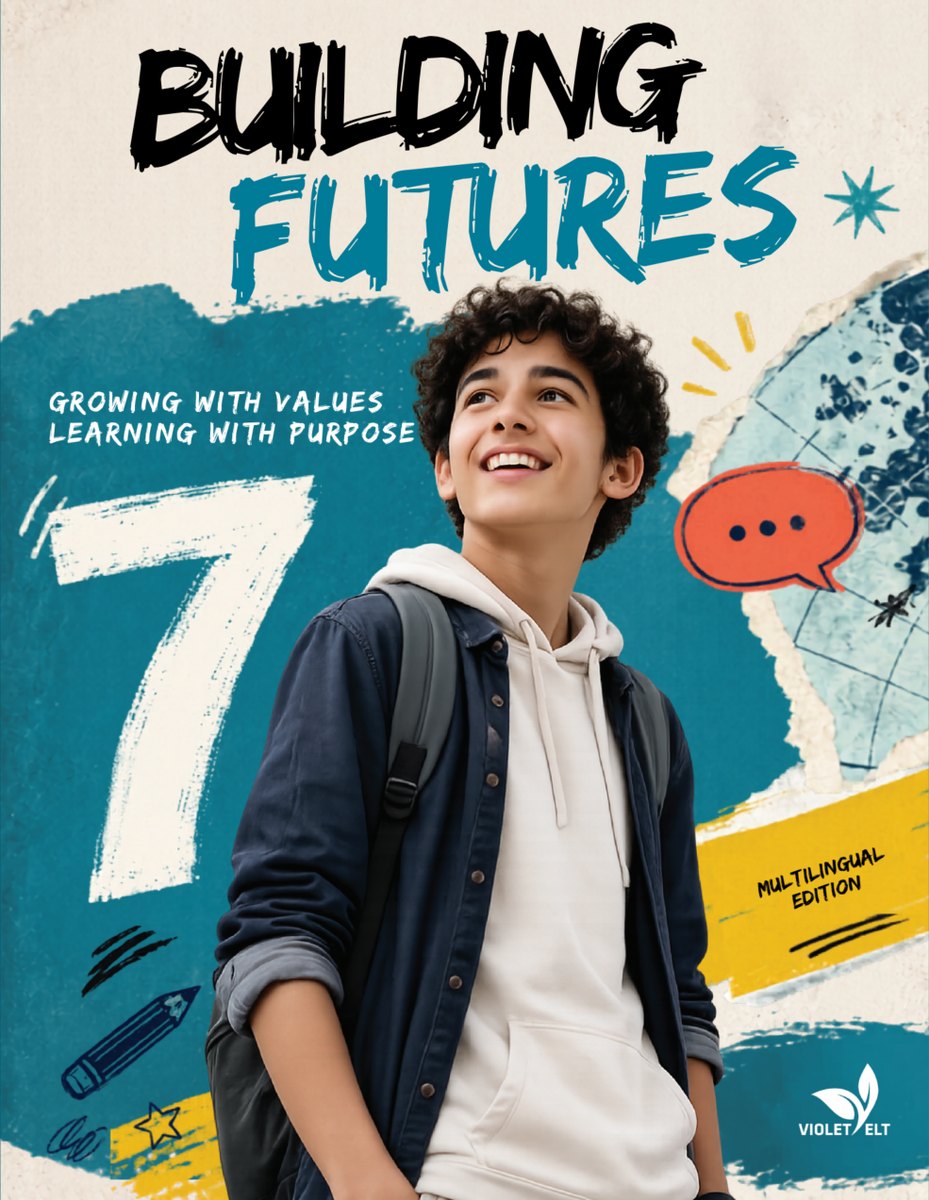
One series.
One method.
Every grade of
the journey.
Building Futures carries learners from their very first English words at age 7 to confident communication at 13, with one consistent pedagogy, one values framework, and a design language that grows up with the child.
A staircase without gaps
Each level hands off precisely where the next one begins. No repeated years, no sudden leaps: a calibrated CEFR climb from absolute beginner to the threshold of independent use.
Bar height maps each level to its CEFR band. The Multilingual editions sit above their general-strand counterparts because of their intensive hours and denser syllabus.
Built for the Maarif Model, not retrofitted around it
For state and ministry buyers this means point-for-point compliance. For private schools, a modern course that still matches the national framework. For distributors, a product line with no adoption barriers.
- Themes and hours. Every unit is one official ministry theme, honouring the allocated teaching hours: from 96 periods in Grade 2 to 216 hours in the intensive Grade 6 Multilingual edition.
- Vocabulary and structures. Target words come only from the ministry "Target Vocabulary in Use" lists. Every required structure is mapped unit by unit, verifiable in the series' internal alignment reports.
- Values and assessment. Türkiye's 20 core educational values are curated across the units, and each theme's project adapts the official Performance Assignment, rubric included.
Six principles, applied
from the first page to the last
The same pedagogy runs from Grade 2 to Grade 7 Multilingual. What changes is the learner, not the method.
Discover, don't drill
Every word and structure is met inside a story before it is ever practised: an animated digital story in the primary years, rich multi-format listening at secondary. Nothing is pre-taught cold, and nothing is tested before it has been met in context.
Story first
Learners watch or listen before anything else. A 1 to 5 minute story carries all the unit's target language in one memorable context: characters, plot, emotion.
Back into the text
Guided-discovery tasks send learners back into the story to find the words and patterns they already understood. Language is recovered, not introduced.
Ending in the personal
Practice climbs from controlled to free, always ending in personalisation: the learner saying something true about their own world.
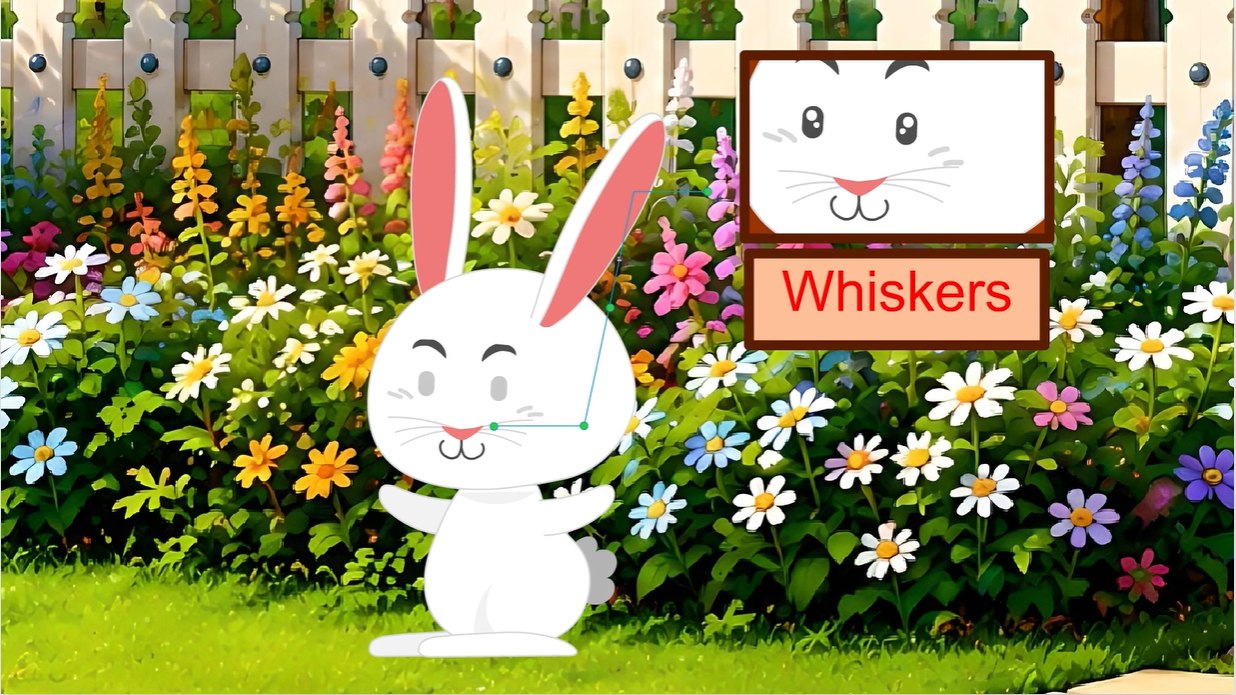
18 original animated stories anchor the primary books. The Multilingual editions build each unit on three natural listening tracks plus a CLIL listening: 64 scripted audio pieces across the strand.
Grammar without grammar-speak
A strong reassurance for parents and a clear differentiator against rule-heavy competitors. Teachers still get the rules: per-unit Grammar References put the explicit knowledge in the teacher's hands, not the child's book.
Rule boxes. Conjugation tables. Metalanguage: no "subject", "auxiliary" or "past participle". No Turkish grammar explanations on student pages.
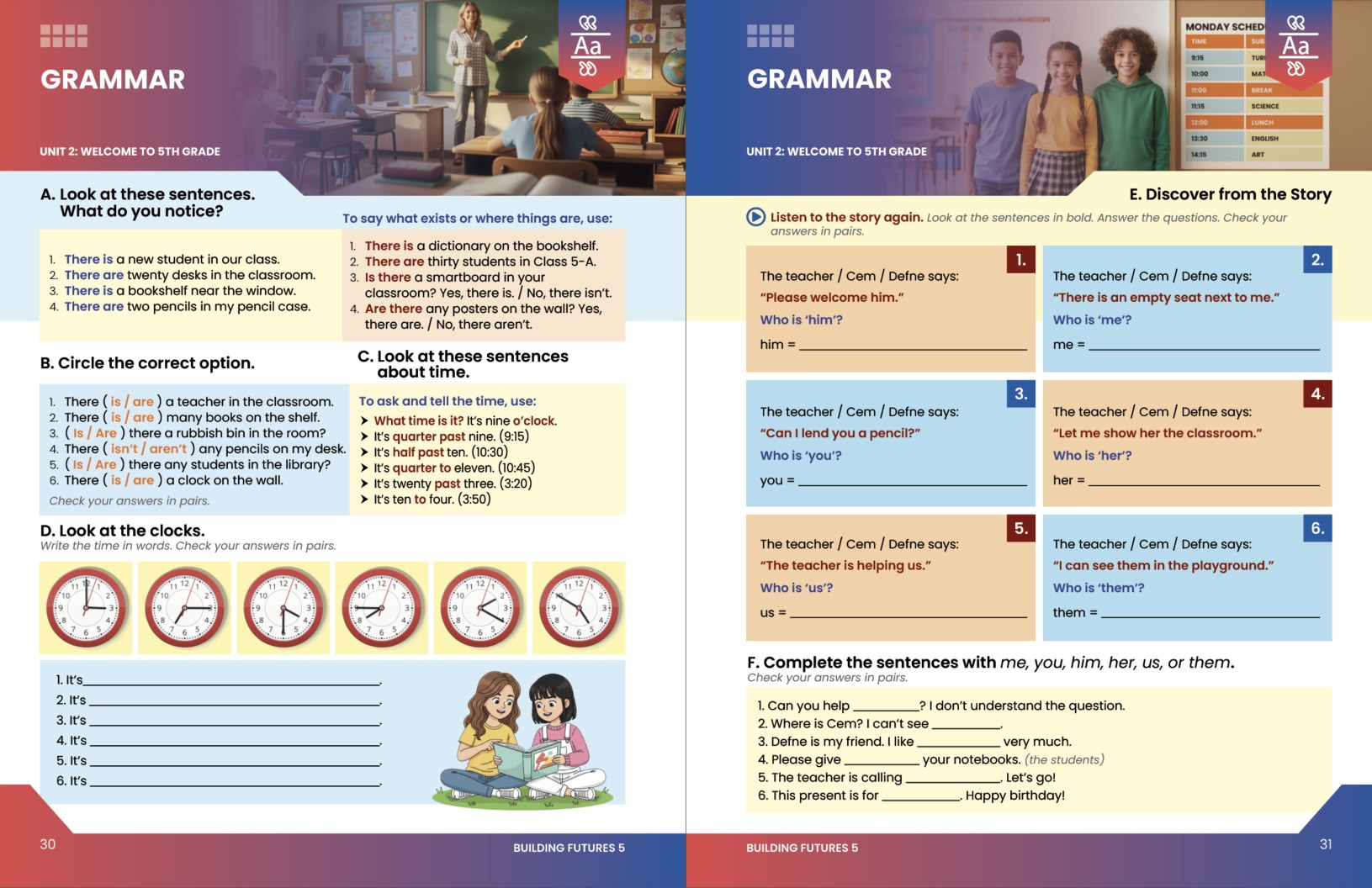
Chunks in context. Structures met inside the story, noticed through look-and-think questions, shown as picture-supported pattern boxes, then used: recognition → controlled → guided → free.
The same method carries remarkable weight as learners grow
Grade 2
Fixed chunks: "I've got…", "It's a…"
Grade 3
Noticed patterns: there is/are, can, must
Grade 4
Past, present and future: the full A1 spine
Grade 5
~30 structures via "Structure + Function" boxes
Grade 6
Narrating past and future; question tags everywhere
Grade 7 ML
Passives, conditionals, wish. Still zero rules.
Values, lived and never lectured
On student pages a value is always a concrete first-person action with an illustration, never an abstract label.
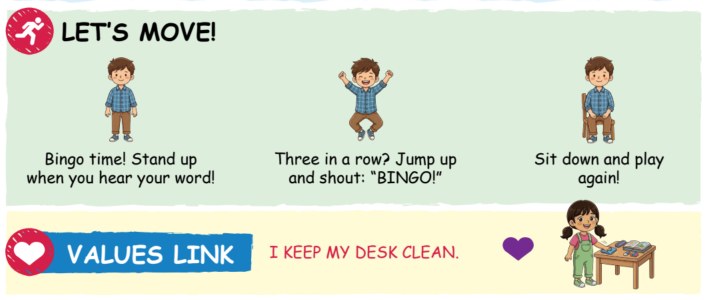
- Türkiye's 20 core educational values, curated to 2 or 3 per unit across every level of the series.
- Always concrete: "I help my new classmate." · "I keep the sea clean." · "I don't waste food."
- Values appear at fixed points: the unit opener, inside the story, in the project, and in a closing self-reflection checklist.
- Social-emotional learning is structural: cooperation, self-awareness and responsible decision-making are built into pair work, group roles and reflection.
Bodies move, hands make
Engagement is engineered, not hoped for. The mechanism matures with the learner.
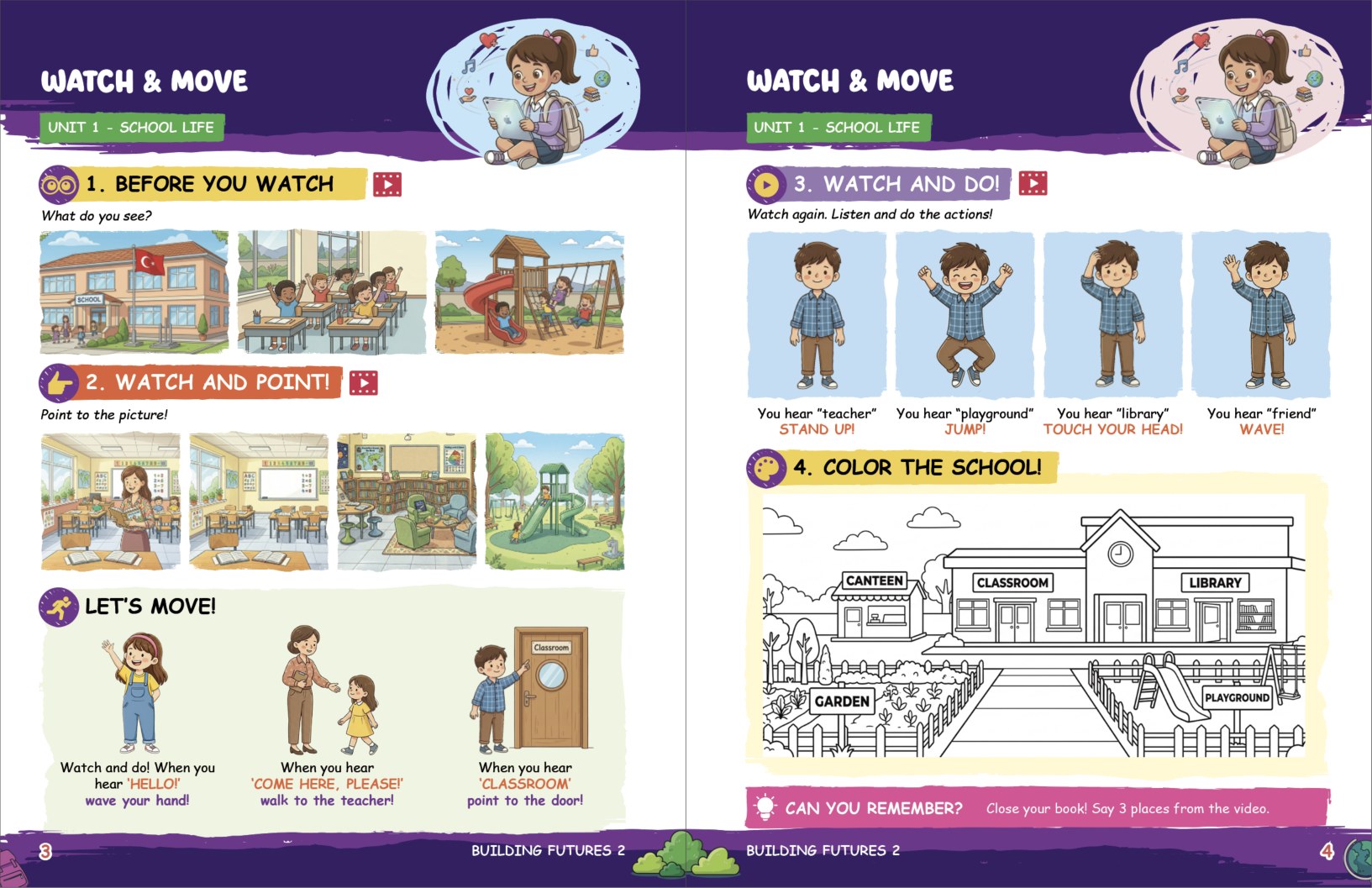
Grade 2 has movement in every single section, even inside the videos: "Point to the library!" Grade 3 carries 70+ "Let's Move!" moments. Children respond physically before they must speak, lowering the affective barrier.
Movement-based speaking tasks continue, and every unit now ends in a collaborative project with rotating group roles, plus a second, lighter CLIL project. Up to 16 hands-on builds per book.
The cognitive climb, engineered into every unit
Recognise
Label
Use chunks
Personalise
Produce
Task demand visibly grows within each unit, never point-and-match on repeat. Spaced "Can You Remember?" retrieval boxes between sections make it stick.
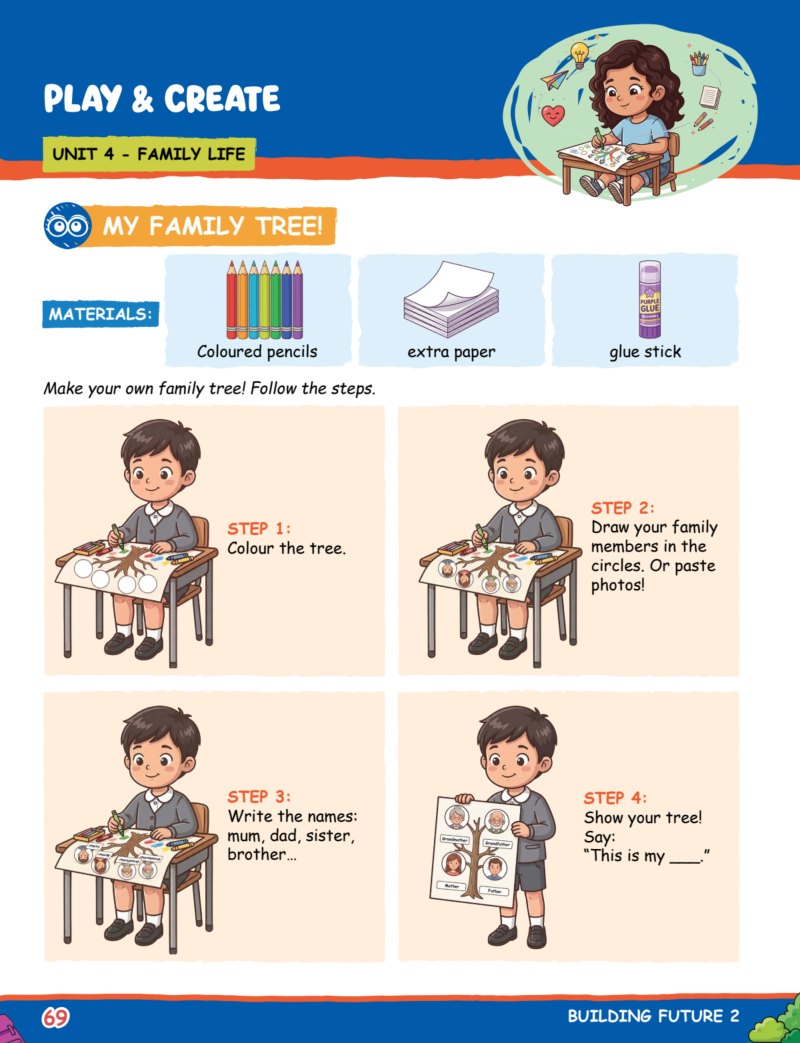
English as it actually exists
From the first grades, learners read and produce real text types, not coursebook-ese.
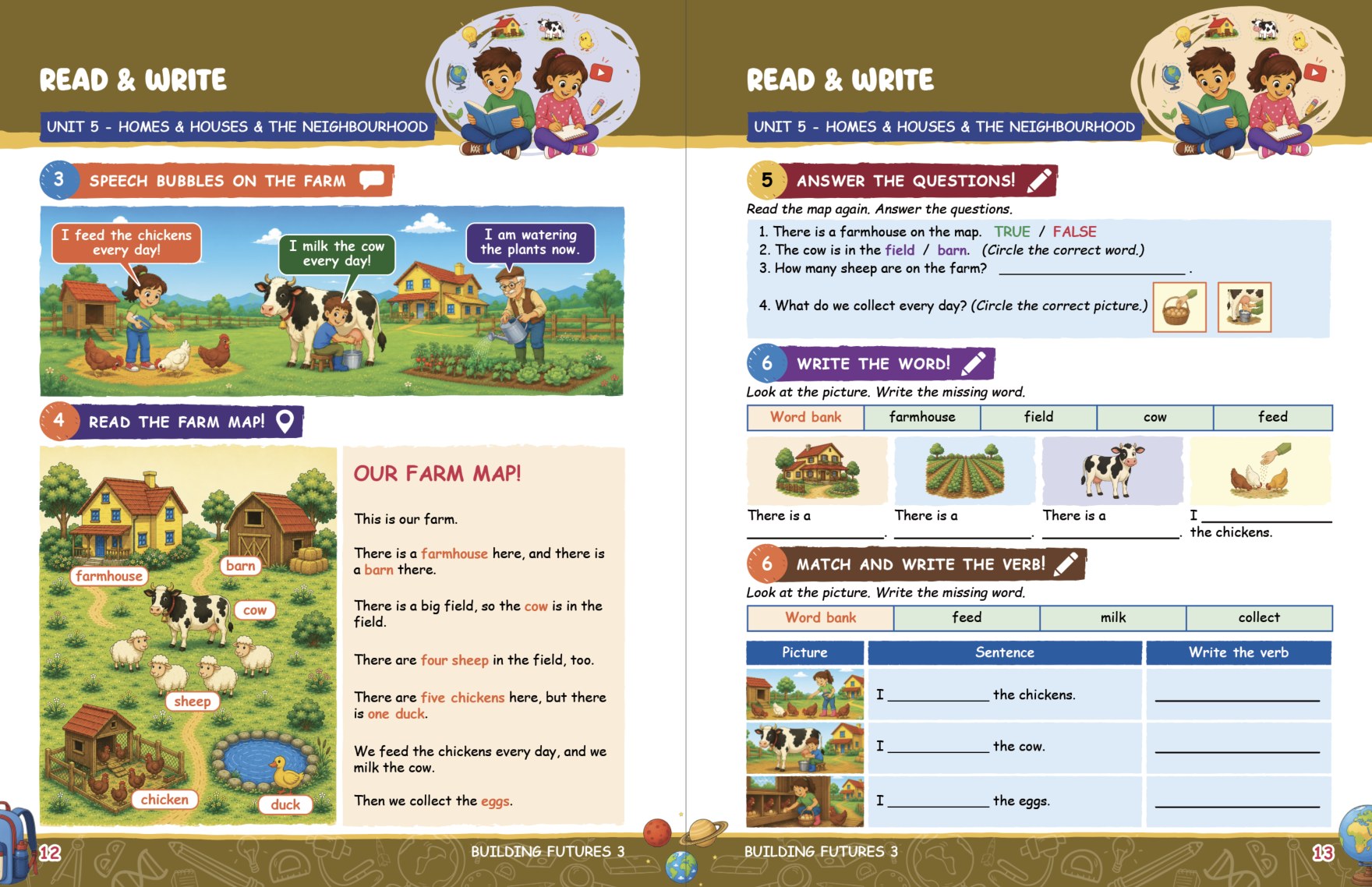
Grade 3 reads a real document every unit: an invitation, timetable, weather card, fridge note, farm map, café menu.
Grade 4 rotates real genres: poster, personal letter, family album, mini-CLIL info text, travel brochure.
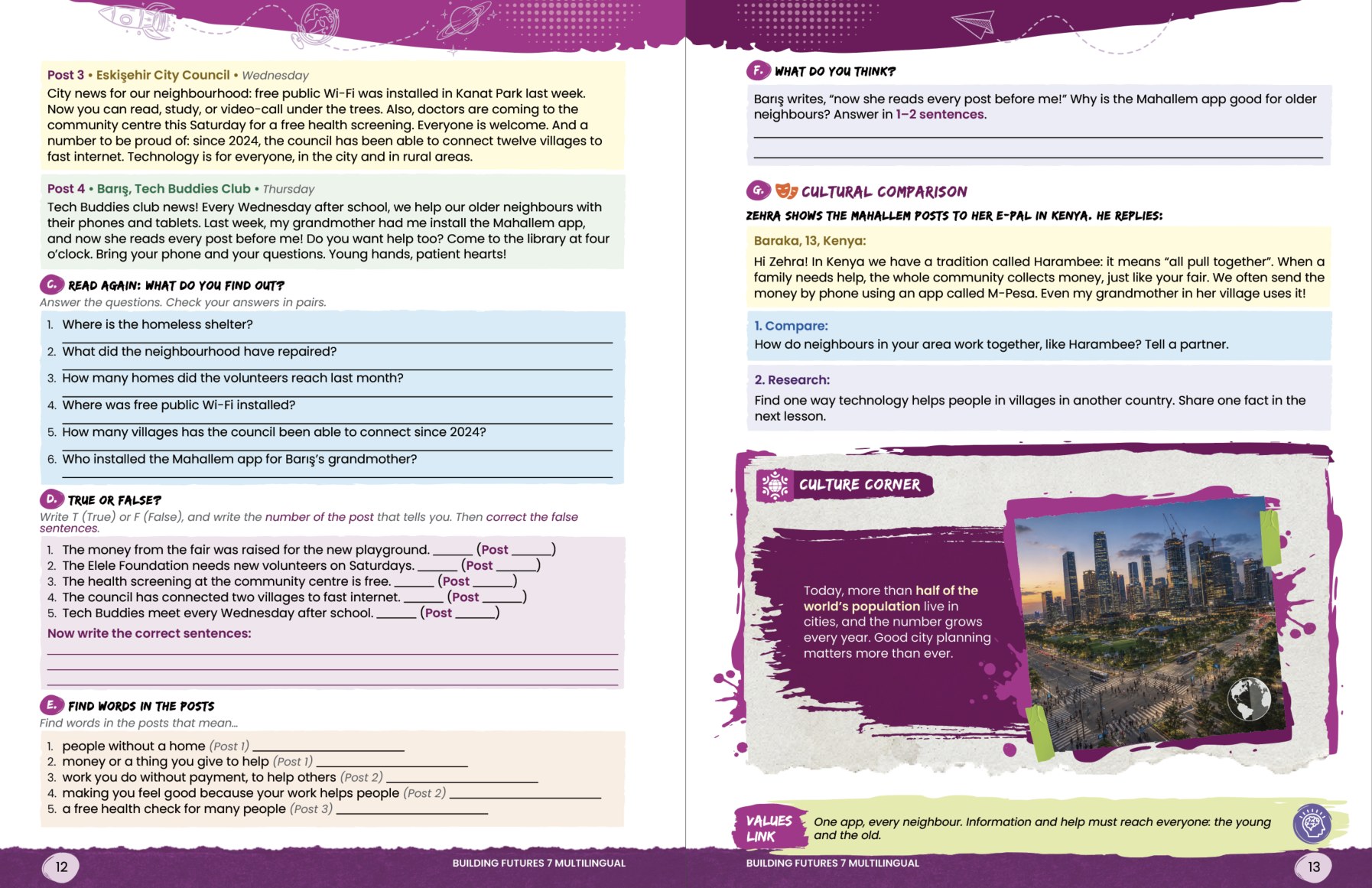
From Grade 5: chat threads, social posts, vlogs, podcasts, voice notes. Plus idioms people actually say: "That's the lion's share!"
Every Multilingual unit ends its reading with a Cultural Comparison from a peer abroad, from Japan's o-souji to Finland's recess.
Assessment that builds confidence, not fear
Self-assessment matures with the child, from a coloured face at seven to CEFR can-do statements at thirteen.
The emoji check
Children colour a happy, neutral or unsure face against simple "I can" and "I do" statements: language and values, self-judged.
The star check
A star-colouring self-check closes every unit: two language goals plus two values behaviours. Low-stakes, visual, honest.
Can-do statements
Six to eight CEFR-style can-do statements per unit across all four skills, plus a values reflection checklist.
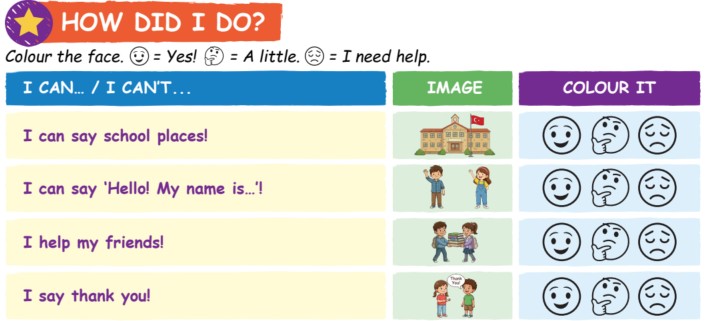
- Peer-checking is a ritual. "Check your answers in pairs" follows every practice task, building self-correction habits.
- Every theme carries a rubric-assessed performance assignment: the ministry's own model, made classroom-ready.
- Verified answer keys for every unit. In the Grade 6 Multilingual edition alone, over 1,000 gradeable items are keyed and checked.
And the people who deliver it
Large classes, mixed ability, sometimes non-specialist. Building Futures is engineered for the classroom as it is, not as we wish it were.
No cutting from the book, no teacher-prepared materials, no room rearranging. Everything runs on paper, pencils and crayons.
Primary Teacher's Books use a colour-coded CORE / SUPPORT / EXTEND structure: the essential procedure, differentiation and L1 guidance, and five to six extra low-prep games per section.
Support and Challenge activity variants, word banks, sentence frames, and enrichment and support notes in every secondary unit. Mixed-ability is the default assumption.
Per-unit answer keys, A–Z teacher glossaries (651 defined entries in BF 6 Multilingual), and Grammar References with board-ready summaries behind every chunk.
Eight books,
one journey
The primary years (Grades 2–4, ages 7–10, Pre-A1 to solid A1), lower secondary (Grades 5–7, ages 10–13, A1 to the B1 threshold), and the intensive Multilingual editions for Grades 6–7.
Where the journey begins
- The most visual book in the series: 80 : 20 pictures to text. Genuinely usable by pre-literate, true-beginner seven-year-olds.
- Movement in every single section, with TPR cues even inside the story videos. The most kinaesthetic level.
- Six 1 to 2 minute animated stories introduce every word in context before any page work begins.
- Zero explicit grammar. To be, have got, there is/are live entirely inside repeated chunks. No intimidation for children or their teachers.
- A structured A–Z phonics strand and trace-and-copy writing meet children exactly where their literacy is.
numbers and colours
13 per unit
include TPR
The bridge year
- Where reading and writing come online. The visual ratio shifts to 65 : 35, and children read their first connected multi-sentence texts, safely inside Pre-A1 → A1.
- Authentic realia reading in all six units: a birthday invitation, a class timetable, a weather card, a fridge note, a farm map, a café menu. Children learn to read the documents they will actually meet.
- A real A1 grammar set taught by pattern, not rules: there is/are, have got, can, must/mustn't, present continuous and simple.
- Strong CLIL for an eight-year-old book: counting in tens, weather science, healthy habits, even reading a café bill.
- A recurring Turkish cast (Elif, Mehmet, Zeynep, Ms. Aydın) returns from Grade 2. Continuity children invest in.
one per unit
TPR moments
across 6 stories
A1, made solid
- The full A1 grammar spine: past, present and future, through picture-only Pattern Boxes. Was/were, past simple, could, comparatives, will, be going to. The widest structural range in the primary series, with zero metalanguage.
- Text finally does real work. Every unit carries a genuine 8 to 10 sentence reading in a rotating real genre.
- A cast that grows with the child. Class 4-A runs through all six units; shy Kaan literally becomes the class storyteller.
- Real communication with report-back in every unit: surveys, reporter interviews, info gaps, always ending in full-sentence reporting.
- Zero-prep, zero-cut crafts that rotate every unit: invitation card → poster → family mini-book → lift-the-flap → brochure.
recycled in 3+ sections
families
activities
Secondary school, started right
- A genuinely implicit grammar engine at exactly the right moment. Around 30 structures absorbed from story context, never a rule box in sight.
- Each unit is driven by one 4 to 5 minute digital story: a coherent narrative hook for ten hours of lessons.
- A complete pronunciation journey: every letter-sound a–z across the year, intonation patterns, and the exact minimal pairs Turkish speakers struggle with (/w/–/v/, /θ/–/ð/, /ɪ/–/iː/).
- A widening thematic arc from the classroom desk to the universe. Perfect recycling, satisfying progression.
- Modern, age-true framing: chat messages, voice notes, drones, recycling tech, Türkiye's space programme.
eight themes
group projects
coverage in one year
The time-travel grade
- Learners break out of the present. Grade 6 is where pupils start narrating the past (simple past, was/were) and planning the future (will, be going to). Telling real stories in English.
- Question tags as a signature skill, built systematically across present, past and future. Conversational English that sounds genuinely fluent.
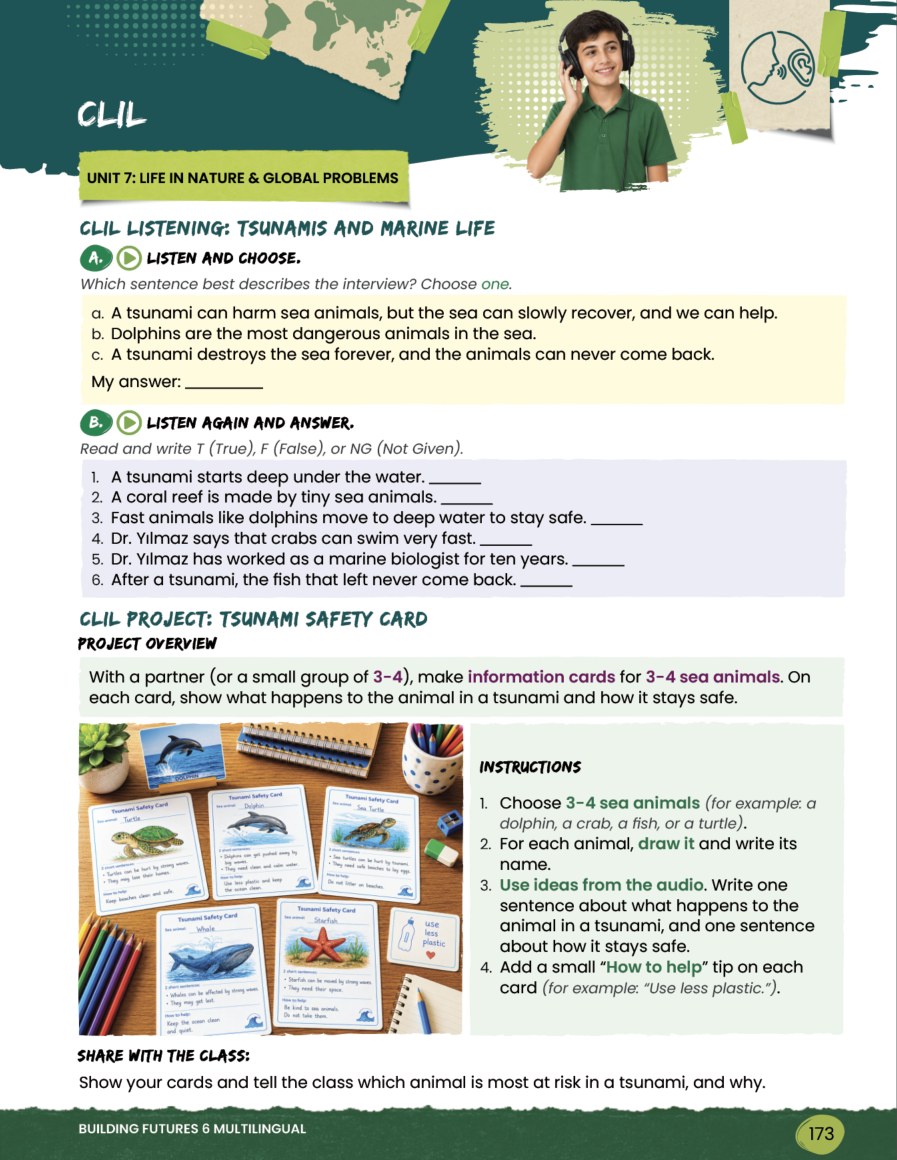
- Eight built-in CLIL modules: the International Space Station, rainforests, bike-friendly cities, young inventors. A light CLIL programme inside the English course.
- Three text encounters per unit (animated story, theme reading and CLIL reading): unusually high input mileage for the level.
- Structures like question tags and comparatives acquired without ever meeting a rule. Reassuring for parents, distinctive against competitors.
one CLIL per unit
CLIL vocabulary
across the book
Grade 6, at full depth
- Purpose-built for the new Maarif Grade 6 curriculum, not a re-skin. Vocabulary only from the ministry list; every unit's project is the official Performance Assignment.
- A complete lower-secondary grammar arc in one year: perfect tenses, modals of deduction, relative clauses, conditionals. All as chunks-in-context, no rules.
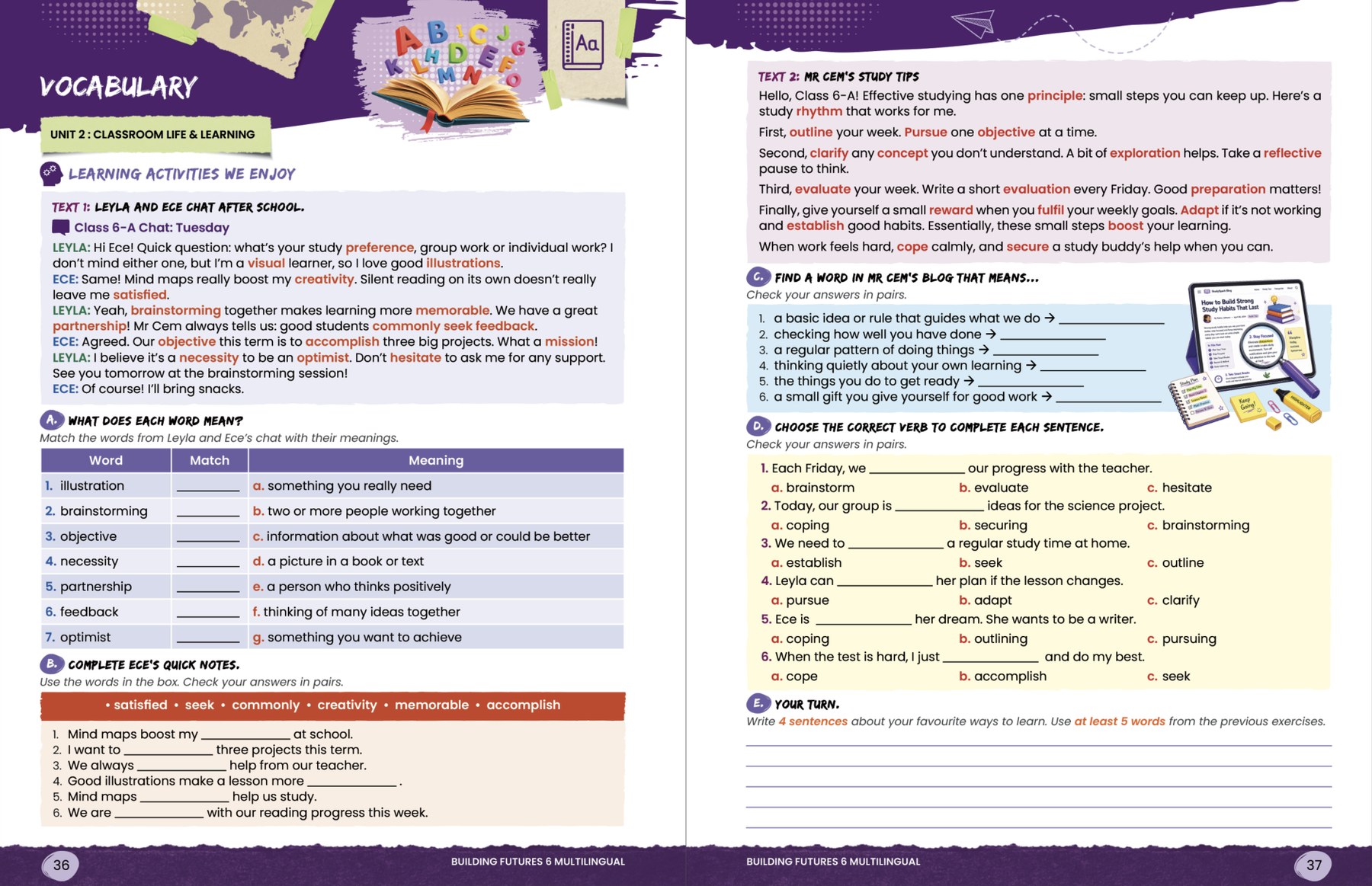
- An integrated one-page CLIL module in every unit: a homework app built by a twelve-year-old, bike-friendly cities, tsunamis and marine life.
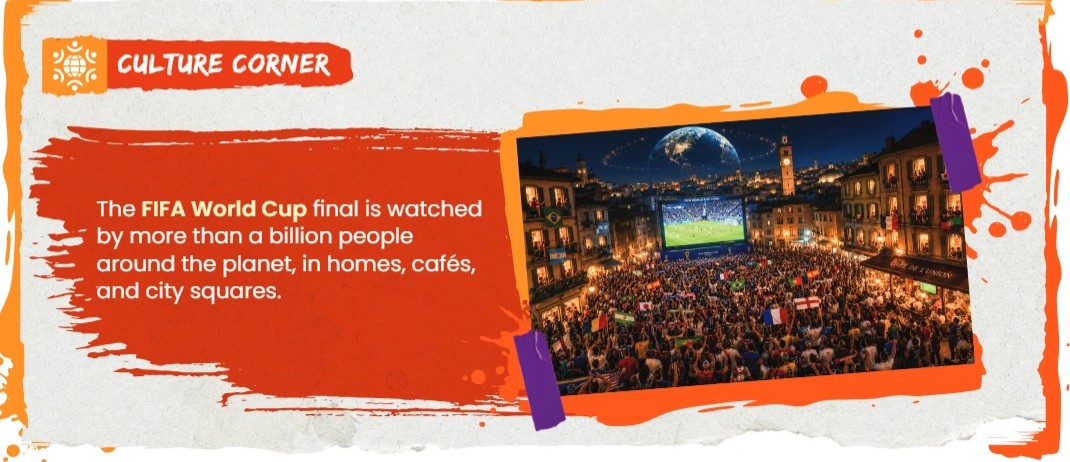
- Cultural Comparison and Culture Corner in every reading, from Japan's o-souji to Finland's recess.
- Teen-true texts with naturalness-controlled audio: chat threads, vlogs, podcasts, voice messages that sound like real speech.
teacher glossaries
pieces
gradeable items
The capstone
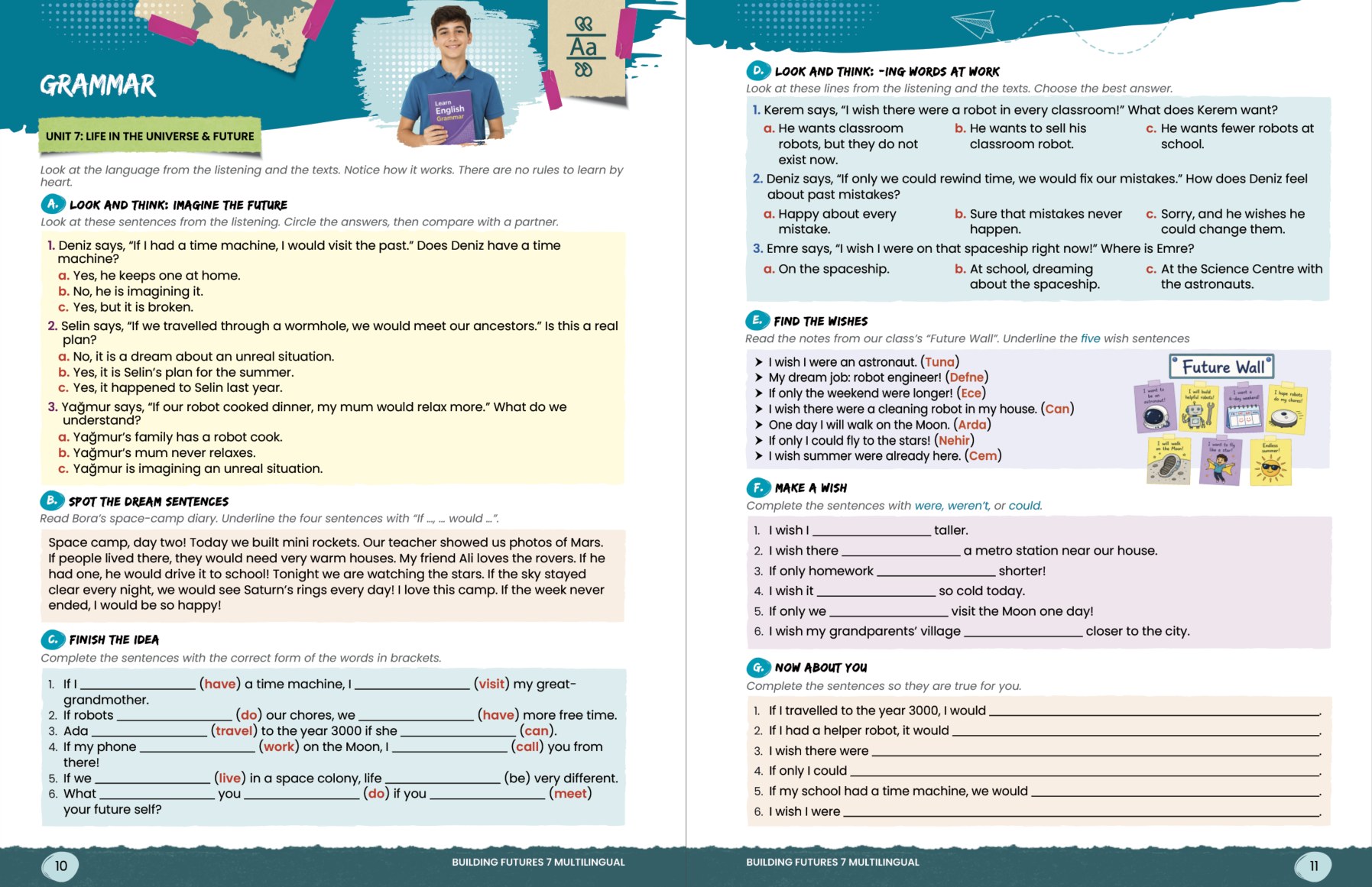
- The step-up grammar that unlocks real expression: passives across present, past and future, causatives, the second conditional, relative clauses, wish / if only. All kept accessible as usable chunks.
- A vocabulary engine built for a heavy syllabus: around 583 target items in two-context mini-cycles, with at least 80% of every cluster actively practised. Nothing dumped.
- Themes that grow up with the learner: social media and sleep, helping your neighbourhood, global problems, time travel and robots.
- The intercultural identity made concrete. Every unit ends with a peer from another country, a research question, and a share-worthy world fact.
- Each unit's project is the ministry Performance Assignment, redesigned as a classroom-ready group activity.
zero grammar jargon
items
rigour you can audit
The B1 bridge
- The crossing into independent-user territory. Learners move from describing to explaining, justifying and predicting: comparatives, past narration, will, must/should, reasons with because.
- Two projects in every unit: a collaborative in-class build plus a fully independent homework project. 20 portfolio artefacts per learner across the book.
- Item-for-item syllabus compliance: 10 official themes, 63 official outcomes, and all 177 wordlist items, with zero off-list vocabulary permitted.
- Speaking as a full section with a compulsory movement task in every unit, recycling only language learners have already met.
- Edition note: built to the current official Grade 7 syllabus, with the Maarif values framework woven through. A fully Maarif-native edition is in development.
and homework
zero off-list
mapped
| Book | Grade | Age | CEFR | Units | Headline figure | Signature strength |
|---|---|---|---|---|---|---|
| BF 2 | Grade 2 | 7 | Pre-A1 | 6 | 100% of sections use TPR | The most visual book in the series, 80 : 20 pictures to text |
| BF 3 | Grade 3 | 8–9 | Pre-A1 → A1 | 6 | 6 realia documents | Reading and writing come online through real documents |
| BF 4 | Grade 4 | 9–10 | A1 | 6 | 199 student activities | The full A1 spine: past, present and future, no metalanguage |
| BF 5 | Grade 5 | 10–11 | A1 → A1+ | 8 | ~440 target words | A complete a–z pronunciation journey in one year |
| BF 6 | Grade 6 | 11–12 | A1+ → A2.1 | 8 | 16 projects | Narrating the past and planning the future; question tags |
| BF 6 ML | Grade 6 | 11–12 | A2 | 8 | 651 target words | 216 ministry hours: the full lower-secondary grammar arc |
| BF 7 ML | Grade 7 | 12–13 | A2 → A2+ | 8 | 48 target structures | Passives, causatives and conditionals, still as chunks |
| BF 7 | Grade 7 | 12–13 | A2 → B1 | 10 | 63 official outcomes | Item-for-item syllabus compliance and 20 portfolio projects |
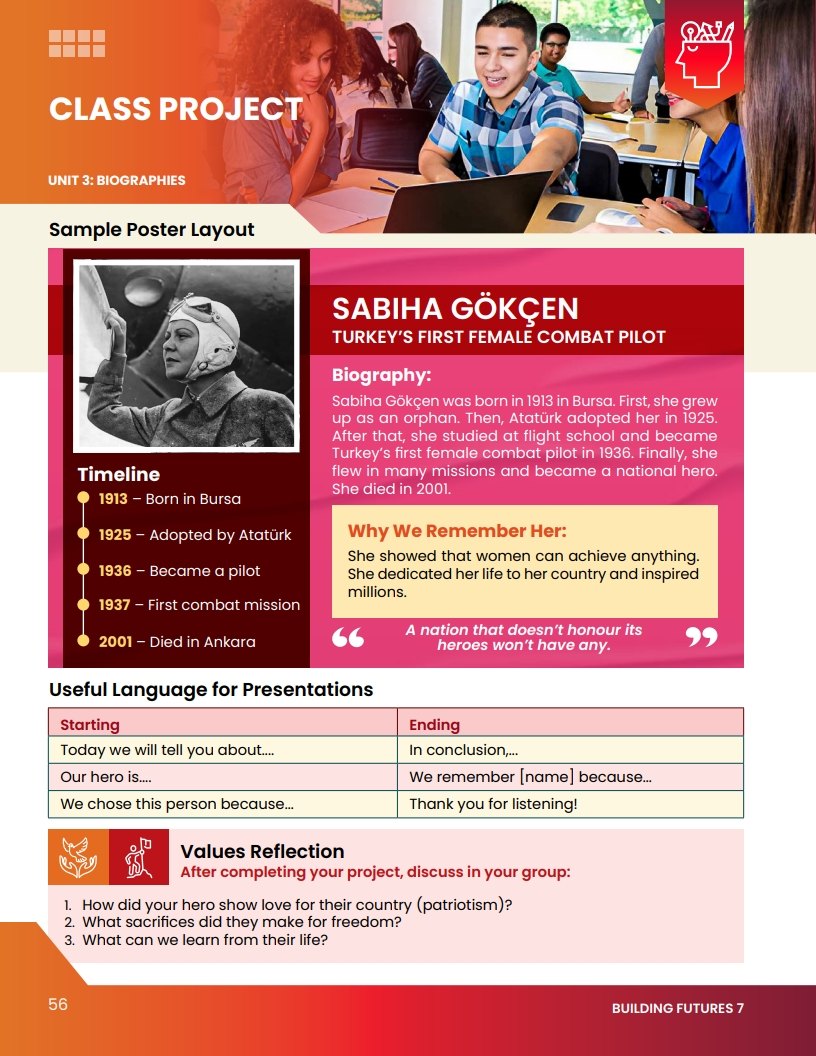
Building Futures 7 is built on the current official Grade 7 syllabus with the Maarif values framework woven through. A fully Maarif-native Grade 7 edition is in development.
Built for Türkiye's Multiple Foreign Language Education Model
For Grades 6 and 7, Building Futures offers a second strand: editions engineered for schools following the intensive Çoklu Yabancı Dil Eğitim Modeli framework. Nearly three times the teaching hours, a far denser syllabus, and an intercultural outlook in every unit.
Annual teaching hours, general strand against Multilingual
~80 core hours per year · ~300 new target words · story-driven units with a CLIL extension. The complete national-curriculum course.
216 and 192 ministry hours · up to ~651 target words · three listening tracks per unit, cultural comparison in every reading, and the full lower-secondary grammar arc.
"Multilingual" is the name of the ministry framework these editions follow. The books themselves are entirely in English.
Watch the same child grow
Each line uses only language taught at that level. This is the ladder, in a child's own words.
Scale you can verify
A complete
teaching system
Every book in the series arrives with the same six components, prepared to the same standard.
Student book
Full-colour coursebooks on a fixed unit spine (nine sections at primary, 12 to 15 at secondary), with practice built in.
Teacher's guide
Three-tier CORE / SUPPORT / EXTEND notes at primary; enrichment and support differentiation in every secondary unit.
Answer keys
A verified key for every unit of every book: objective answers plus sample answers and acceptance notes for open tasks.
Stories and audio
Animated digital stories through Grade 6; a fully scripted, naturalness-controlled audio programme in the Multilingual strand.
Teacher references
Per-unit A–Z glossaries and Grammar References with board-ready summaries: the explicit knowledge, teacher-side.
Complete art direction
A professional illustration brief for every page and every scene: a consistent visual world across books and videos.
Five reasons schools say yes
One journey
Pre-A1 to B1 with one method, one cast of values, and hand-offs without gaps. A school adopts a ladder, not a shelf of unrelated books.
Ministry-native
Built to the Maarif Model from the first page: themes, wordlists, hours and performance assignments, all auditable against the official documents.
Discovery pedagogy
Stories first, grammar as chunks, zero metalanguage. Modern methodology that parents can feel in their child's confidence.
Values at the core
Twenty national values lived as first-person actions and reflected on by learners themselves, not printed as a list in the front matter.
Teacher-friendly
Zero-prep activities, tiered notes, verified keys and references. Built for real classrooms with real constraints.
Whether you adopt one grade or the whole ladder, every classroom gets the same promise: children who discover English, and grow while doing it.
vBook: the whole
series, on the board
Every level comes with vBook, the series' interactive whiteboard software. The complete course lives on screen, so teachers run the whole lesson from the front of the room.
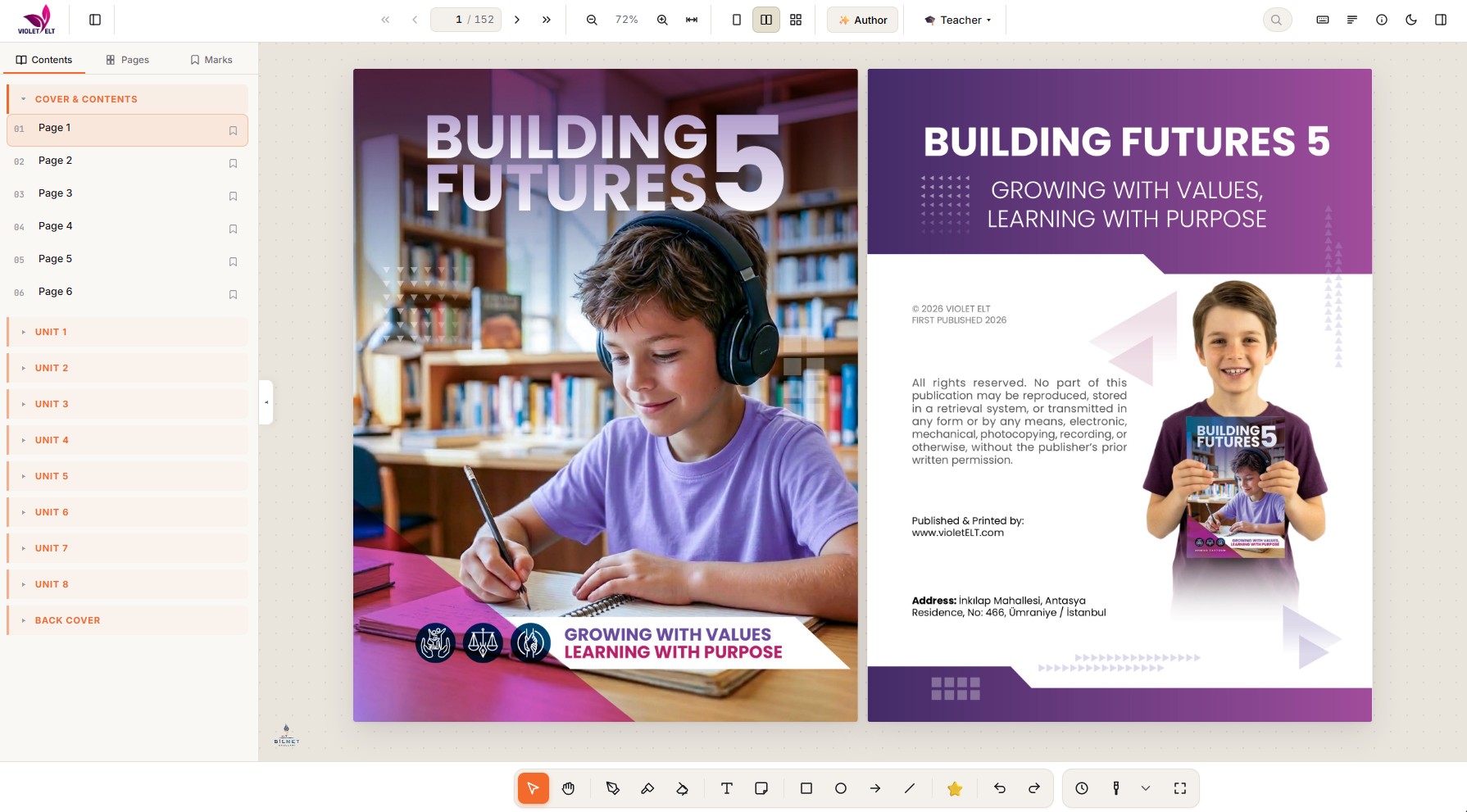
Full books on screen
Every page of the coursebooks, zoomable and navigable for front-of-class teaching.
Audio and video in place
The digital stories, listening tracks and videos play from the very page they belong to.
Built-in references
The grammar guide and vocabulary lists, one tap away at any moment of the lesson.
Answers on demand
Reveal the answer key on the page for instant whole-class checking.
Let's build futures together.
Adoption options, samples and commercial details: we would love to discuss them with you in person.
A complete English course · Grades 2–7